
Side Dishes
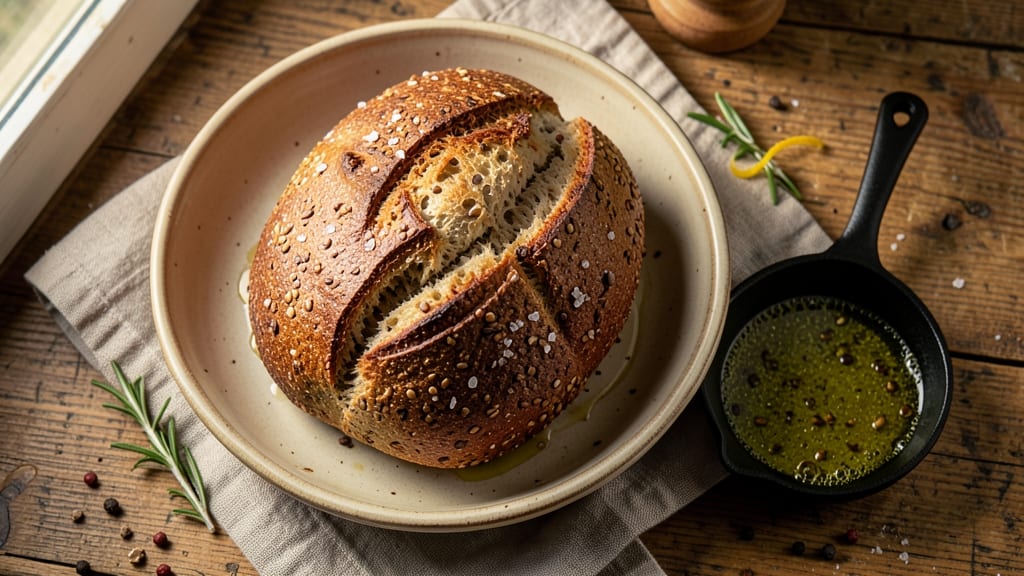
This gluten-free ancient grains bread delivers the perfect balance of nutty crunch and pillowy softness—a game-changer for anyone who misses artisanal bread but needs a grain-free option.
The secret lies in blending farro, spelt, and buckwheat flour with a touch of xanthan gum for structure, creating a loaf that’s both hearty and tender. Unlike dense gluten-free breads, this recipe achieves a light, airy crumb while keeping the crust crisp and golden.
What sets this apart is the two-stage mixing method, where we first hydrate the ancient grains to unlock their natural nuttiness before combining with a simple yeast-based batter. No-knead dough rests for 90 minutes, allowing flavors to meld and gluten-free adaptations to work their magic.
The result? A loaf with visible flecks of toasted grains and a texture that’s surprisingly close to traditional sourdough.
Baking at 375°F for 40 minutes yields a loaf with a caramelized crust and a crumb so tender it practically melts in your mouth. The nutty depth from the grains pairs beautifully with olive oil and sea salt, making it ideal for toast, sandwiches, or served alongside soups.
With no artificial binders and just 8 ingredients, this is gluten-free baking at its finest.
Store wrapped at room temperature for 3 days or freeze for up to 3 months—perfect for meal prep. The recipe scales easily, so double it for a crowd or halve it for smaller batches. Ready to bake bread that actually feels indulgent?
Ingredients for ancient grains bread recipe gluten free
Eight carefully chosen ingredients transform into gluten-free bread with artisanal texture and depth.
| Ingredient | Amount | Notes |
|---|---|---|
| Farro Flour 🌾 | 1 ½ cups | Toasted for enhanced nuttiness |
| Spelt Flour 🌾 | 1 cup | Stone-ground preferred |
| Buckwheat Flour 🌾 | ½ cup | Rich, earthy flavor profile |
| Xanthan Gum 🧪 | ½ tsp | Ensures proper gluten-free structure |
| Active Dry Yeast 🍞 | 1 tsp | Freshly packaged for potency |
| Extra-Virgin Olive Oil 🫒 | ½ cup | High-quality for rich flavor |
| Granulated Honey 🍯 | 2 tbsp | Natural sweetener and yeast activator |
| Sea Salt 🧂 | 1 ½ tsp | Fine grain preferred |
| Warm Water 💧 | 1 ¼ cups | 105°F for optimal yeast activation |
| Ground Flaxseed 🌱 | 1 tbsp | For added fiber and binding |
| Toasted Sesame Seeds 🌰 | 1 tbsp | Optional garnish for texture |
The ancient grains are the heart of this recipe. Bob's Red Mill carries excellent farro and spelt flours, but King Arthur offers a pre-mixed gluten-free blend that works beautifully too. For buckwheat, look for 100% pure buckwheat flour—some blends contain wheat fillers. Toasting the farro before mixing (dry pan, 3-4 minutes) unlocks its nutty potential. Xanthan gum is non-negotiable here—it mimics gluten's binding properties, and Bob's Red Mill sells it in small packets perfect for this recipe. If you can't find it, psyllium husk powder at half the amount works in a pinch, though texture will differ slightly.
No xanthan gum? Psyllium husk powder at half the amount is the closest substitute, though results may be slightly denser. Swapping flours? Brown rice flour can replace up to half the spelt, but expect a nuttier flavor. For the honey, maple syrup or agave nectar work in equal measure, though honey's yeast-activating properties are unmatched. The yeast must be fresh—if it's past its expiration, proof it first in warm water with a pinch of sugar to confirm it's active. Sesame seeds are optional but add a delightful crunch; toasted poppy seeds
This dough requires 90 minutes of resting time—don't skip it. Cover loosely with a damp towel to prevent drying. For longer storage, wrap the cooled loaf in parchment paper followed by foil—keeps it fresh for 5 days at room temperature. Freezing is ideal: slice the loaf, wrap each piece individually in plastic, and store for up to 3 months. To revive, toast directly from frozen for 3-4 minutes at 350°F. The crust develops best when baked in a preheated Dutch oven—if you don't have one, a baking stone works nearly as well.
Why You'll Love This Recipe
- I swear by this combo: just whisk the flours (farro, spelt, buckwheat) with warm water, yeast, and a pinch of xanthan gum—no sifting, no kneading, no stress. The dough comes together in minutes, and honestly? It’s the closest gluten-free bread has ever felt to real bread.
- This bread handles everything: thick slather of almond butter for lunch, charred grilled cheese at dinner, or even as a base for open-faced soups. I’ve made it for date nights, lazy Sundays, and even packed it for my kid’s school trips—no one ever questions the leftovers.
Step-by-step instructions for ancient grains gluten-free bread
This method delivers a loaf with a crisp, nutty crust and a tender, airy crumb—perfect for gluten-free baking.
Activate the Yeast and Hydrate the Flaxseed
In a small bowl, combine the 1 tsp Active Dry Yeast with 1.25 cups Warm Water (105°F) and 2 tbsp Granulated Honey. Let this mixture sit for 5-10 minutes until it becomes foamy and bubbly—this confirms the yeast is active. Meanwhile, whisk together 1 tbsp Ground Flaxseed with 2 tbsp additional warm water in a separate bowl. The flaxseed will thicken into a gel-like consistency, which acts as a natural binder in place of gluten.
I always test the yeast first—if it doesn’t foam, the bread won’t rise properly. This step ensures your loaf develops the right structure from the start. Keep both mixtures at room temperature while you prepare the dry ingredients.
Mix the Dry Ingredients Thoroughly
In a large mixing bowl, combine the 1.5 cups Farro Flour, 1 cup Spelt Flour, and 0.5 cup Buckwheat Flour. Sift the mixture lightly to aerate the flours, then whisk in the 0.5 tsp Xanthan Gum and 1.5 tsp Sea Salt. The Xanthan Gum is critical here—it mimics the elasticity of gluten, giving the bread its signature structure. Stir well to ensure even distribution of the gum, which prevents a gummy texture later.
I use a whisk for this step to avoid developing too much gluten, even though this is a gluten-free recipe. The flours vary in texture, so thorough mixing ensures a consistent crumb throughout the loaf.
Combine Wet and Dry Ingredients
Pour the yeast mixture and flaxseed gel into the bowl of dry ingredients. Add the 0.5 cup Extra-Virgin Olive Oil and mix with a wooden spoon until just combined. The dough will be sticky but should hold together when pressed—this is normal for gluten-free bread. Avoid overmixing, as it can lead to a dense loaf. If the mixture seems too thick, add 1-2 tbsp warm water to reach a spreadable consistency.
The olive oil adds richness and helps create that crisp crust, while the honey enhances browning and sweetness. Here’s the thing—gluten-free dough behaves differently, so resist the urge to add extra flour. Trust the recipe.
First Rise and Shape the Loaf
Cover the bowl with a damp towel and let the dough rise in a warm place for 1-1.5 hours, or until it has doubled in volume. The dough will look puffy and slightly jiggly when ready. Gently deflate the dough by pressing it down with your fingers, then transfer it to a lightly oiled loaf pan. Shape it into a dome, leaving room for expansion—gluten-free dough doesn’t rise as dramatically as wheat-based dough.
This rise is crucial for developing flavor and texture. If your kitchen isn’t warm enough, place the bowl near a turned-off oven with the light on. The dough should spring back slowly when pressed—this is your cue it’s ready for the oven.
Bake to Golden Perfection
Preheat your oven to 375°F. Bake the loaf for 40-45 minutes, until the top is deep golden brown and the internal temperature reaches 205°F. In the last 5 minutes, sprinkle the 1 tbsp Toasted Sesame Seeds on top for added texture and visual appeal. The bread is done when it sounds hollow when tapped on the bottom.
Let the loaf cool in the pan for 10 minutes, then transfer it to a wire rack to cool completely. This resting period allows the crumb to set properly, preventing a gummy texture. Slice when fully cooled—gluten-free bread is best served at room temperature for maximum tenderness.
Pro Tips For Making Ancient Grains Bread Recipe Gluten Free
- Bloom Yeast First: Skip the guesswork—mix your active dry yeast with warm water (105-110°F) and a pinch of sugar before adding it to the dry ingredients. Ancient grains slow fermentation, so giving the yeast a head start ensures it actually wakes up instead of sulking in your dough.
- Sift the Buckwheat: Buckwheat flour is dense and clumpy—sift it twice before mixing to avoid a brick-like dough. I learned this the hard way when my first batch turned out like a concrete block. Trust me, your kneading (or lack thereof) will thank you.
- Don’t Overmix the Dough: Gluten-free ancient grain dough behaves like wet sand—once it starts holding together, stop stirring. Overworking it triggers gummy textures, and no one wants a chewy loaf that tastes like regret. Aim for shaggy, sticky, not smooth.
- Proof in a Warm Spot: Your oven’s light-on setting (with a bowl of hot water inside) is your new best friend. Ancient grain dough rises slower, and room temp is often too cool—this guarantees a proper rise without waiting forever. (Yes, even if you’re impatient like me.)
Wine and beer pairings for ancient grains bread recipe gluten free
Crisp Whites
This nutty, hearty ancient grains bread pairs beautifully with dry, crisp whites that cut through its richness. A Sauvignon Blanc from New Zealand—like Kim Crawford’s Sauvignon Blanc—is my go-to choice. The citrusy notes and herbal undertones complement the toasted farro and buckwheat flavors perfectly. 🍷
Light Reds
For a red wine pairing, opt for a light-bodied Pinot Noir with bright acidity. A Willamette Valley Pinot from Oregon, such as Domaine Serene’s Pinot Noir, balances the bread’s earthy tones without overpowering them. The red fruit notes harmonize with the honey and olive oil, creating a well-rounded match.
Hoppy Beers
If you prefer beer, a session IPA or pilsner works wonderfully. Omission IPA from Oregon is gluten-free and offers a crisp, hoppy contrast to the bread’s nuttiness. Alternatively, a German Pilsner like Warsteiner provides a clean, refreshing balance that highlights the bread’s caramelized crust.
Sweet Pairings
For a dessert-style pairing, try a Moscato d’Asti—its light sweetness and effervescence mirror the bread’s honeyed notes. If you’re serving with jam or butter, a Riesling with a touch of sweetness, like Dr. Loosen Blue Slate, enhances the experience without clashing.
Coffee and Tea
Don’t overlook coffee or herbal tea as pairings. A medium-roast dark coffee with notes of chocolate brings out the bread’s depth, while chamomile tea offers a soothing contrast to its nutty complexity. Both are perfect for breakfast or a light snack.
Nutrition facts
Frequently asked questions
Can I substitute regular flour for the ancient grains in this recipe?
No, we don't recommend it. Ancient grains like farro, spelt, and buckwheat provide unique textures and flavors that wheat flour can't replicate. The combination creates that signature nutty crunch and tender crumb. If you're avoiding specific grains, try a 1:1 gluten-free blend of brown rice flour and sorghum flour, but expect a different flavor profile.
Why does my gluten-free bread turn out dense instead of light?
Density usually happens from overmixing or skipping the resting time. Gluten-free dough needs 90 minutes of rest to develop properly. Also, avoid adding extra flour—it makes the crumb heavier. Use the xanthan gum as directed and measure ingredients precisely. If the dough feels too stiff, add 1 tbsp warm water at a time until it reaches a spreadable consistency.
How do I know when the bread is fully baked?
The bread is done when it reaches an internal temperature of 205°F and sounds hollow when tapped on the bottom. The crust should be deep golden brown. For extra assurance, insert a toothpick—it should come out clean. Baking times vary by oven, so start checking at 35 minutes if your oven runs hot.
Can I make this bread without xanthan gum?
Yes, but the texture will differ. Replace the 0.5 tsp xanthan gum with 0.25 tsp psyllium husk powder mixed with 1 tbsp water to form a gel. This acts as a binder but may result in a slightly denser loaf. For best results, use both the psyllium gel and the flaxseed mixture together—they complement each other's binding properties.
How should I store leftovers to keep them fresh?
Wrap the cooled loaf in parchment paper followed by foil to maintain moisture. It stays fresh at room temperature for 3 days. For longer storage, slice the bread and freeze individual pieces in plastic wrap for up to 3 months. To revive, toast directly from frozen for 3-4 minutes at 350°F—no thawing required!